
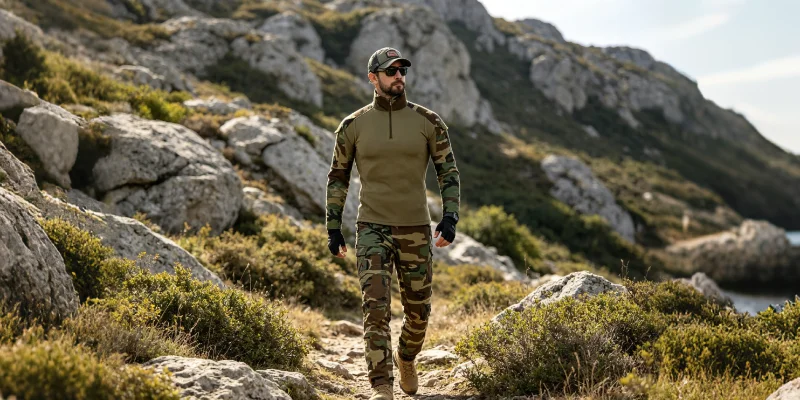
Choosing the right tactical gear manufacturer shapes every downstream decision, from product quality and delivery timing to compliance status and long-term cost control. For procurement teams, private-label brands, and distributors sourcing across tactical, shooting, hunting, and outdoor categories, the stakes are high enough that supplier selection deserves a structured, criteria-driven process rather than a catalog review.
The most important thing buyers can do before signing any agreement is verify that a supplier’s actual production capabilities match what their business model and customer base require. This means going deeper than samples and pricing, and looking closely at compliance records, in-house capacity, quality systems, and the supplier’s experience with the specific product types and order structures that matter to your program.
This guide walks through each evaluation area in practical terms, covering how to assess a manufacturing partner, what compliance and testing requirements to prioritize, which product categories require the most scrutiny, and how to manage the scale-up from prototype to repeat production.
How To Assess A Manufacturing Partner
A strong manufacturing partner brings more than sewing capacity. Buyers should confirm that the supplier can handle design-stage input, material sourcing, prototyping, and consistent bulk execution across the specific tactical gear categories they need.
Core Capabilities Buyers Should Verify
Before entering any agreement, confirm the following:
- Pattern making and technical file developmentin-house, not outsourced
- Experience producing the specific product types you need (plate carriers, load-bearing vests, pouches, packs)
- Demonstrated ability to work from buyer specifications or help develop them from rough concepts
- Capacity to handle government agencies and commercial accounts simultaneously without quality degradation
- Documented production history with custom tactical solutions similar in scope to your program
A capable manufacturer should be able to walk you through their full workflow, from intake of a design file to first sample delivery. If they cannot explain that process clearly, that is itself a risk indicator.
In-House Production Vs Outsourced Processes
Whether cutting, sewing, laminating, and finishing all happen under one roof matters significantly for quality control and lead time reliability. Factories that subcontract core production steps introduce variability that is difficult to audit and even harder to correct after a problem surfaces.
When production is fully in-house, the manufacturer controls material handling, sewing quality, assembly sequencing, and final inspection. That control translates directly into more consistent output and faster problem resolution.
Ask specifically which processes are completed on-site and which are sent to third parties. Request a floor plan or facility overview if needed.
Fit For OEM, Private Label, And Contract Work
Not every tactical gear factory is set up for every commercial model. Some specialize in high-volume OEM runs. Others are better suited for small-batch private label product development or government contract programs with tight specification and documentation requirements.
Confirm that the supplier has prior experience with your specific business model. A factory experienced only in consumer-facing retail runs may not have the documentation discipline or compliance infrastructure required for agency-facing contract work or export programs.
Compliance, Testing, And Production Control
Compliance is not a checkbox exercise in this category. For buyers supplying military, law enforcement, or government-adjacent markets, sourcing requirements and quality standards carry legal and contractual weight that must be verified before production begins.
Berry Compliance And Domestic Sourcing Requirements
Berry compliant products are manufactured in the United States using domestic materials, including fabric, components, and assembly. The Berry Amendment applies to Department of Defense procurement and prohibits the use of foreign-made textiles, fibers, and related materials in covered contracts.
For any program touching federal or DoD procurement, confirming berry compliant status is non-negotiable. Ask suppliers for documentation showing that all materials, from base fabric to webbing and thread, meet domestic sourcing requirements. Some manufacturers maintain full traceability records for this purpose; others do not.
Suppliers that carry established berry compliant product lines typically have this infrastructure already in place, which reduces compliance risk for the buyer.
Quality Assurance Systems And Quality Standards
A factory’s quality assurance framework determines how consistently it can replicate a confirmed specification across hundreds or thousands of units. ISO 9001 certification is a widely recognized benchmark that indicates documented procedures for process control, inspection, and corrective action.
Beyond certification, ask how the supplier manages incoming material inspection, in-process checks, and final product review. Mil-Spec compliance for relevant components adds another layer of assurance for programs where dimensional tolerances, tensile strength, or thread count specifications are contractually defined.
The quality standards a manufacturer holds should align with the end-use requirements of your product line.
Traceability, Documentation, And Lot Control
Traceability means being able to trace a finished product back through its production history, including which material lot was used, when it was cut, and which production line completed assembly. This matters when defects are discovered post-delivery, particularly in government or law enforcement programs.
Strong lot control practices include batch numbering, material certificates on file, and documented inspection records for each production run. Ask to see sample documentation packages from previous orders. If a supplier cannot produce clear traceability records, that gap will become a liability the moment a quality issue arises.
Product Categories And Custom Build Options
Buyers sourcing across multiple product lines need a manufacturer with demonstrated capability across each category, not just depth in one. Breadth of production experience reduces the friction of managing multiple suppliers and supports more coherent custom tactical solutions.
Plate Carriers, Tactical Vests, And Load-Bearing Gear
Plate carriers and tactical vests represent some of the most structurally demanding products in the category. Pattern precision directly affects how weight is distributed and how the carrier sits under load. Even small deviations in cut or seam placement can affect fit and function for the end user.
When evaluating a supplier for these products, confirm they have experience with:
- MOLLE webbing integration and panel construction
- Armor pocket sizing and retention systems
- Adjustable cummerbund and shoulder strap attachment points
- Load-bearing reinforcement at stress points
Prototyping for plate carriers typically takes longer than for simpler pouches or packs, often 10 to 20 days for an initial sample, because of the structural complexity involved.
Expanding Into Shooting, Hunting, And Outdoor Lines
Many tactical manufacturers also produce gear for the shooting sports, hunting, and outdoor recreation markets. From a production standpoint, these categories share significant overlap in materials and construction methods, making them a natural extension for brands that already source tactical products.
Confirm that a supplier’s experience covers the specific products you need in these adjacent lines, such as range bags, hunting packs, or camping systems. A factory experienced with load-bearing military gear is well-positioned technically, but may need additional guidance on retail-oriented feature sets, colorways, and packaging requirements.
Scaling From Prototype To Repeat Orders
Getting to a confirmed sample is only part of the process. The more commercially important question is whether a supplier can execute consistently at volume and sustain that performance across multiple order cycles. Matching product development discipline with production capacity is what separates a capable long-term partner from a capable one-time vendor.
Sampling, Revisions, And Pre-Production Validation
The sample phase is where most production problems are either resolved or locked in. A first sample typically surfaces fit, material, and construction issues that require one to three rounds of revision before the design is stable.
A pre-production sample (PPS) should be the final confirmed version, signed off on materials, construction, and specifications before bulk production begins. Any design changes after PPS approval add cost and delay. Buyers who enter bulk production without a confirmed PPS take on significant rework risk.
Set clear revision limits and decision timelines at the start of the sampling phase to keep the process on track.
Lead Times, Capacity Planning, And Delivery Reliability
Bulk production for tactical products typically runs 25 to 60 days depending on order size and product complexity. Material availability is consistently the largest source of delay, accounting for a significant share of total project lead time in many cases.
When evaluating a supplier, ask:
- What is the current production queue and capacity availability for your target window?
- How far in advance must materials be confirmed to meet a target ship date?
- What is the supplier’s track record on on-time delivery for repeat orders?
Planning for material lead time at the start of each production cycle prevents the most common cause of late delivery.
Building Long-Term Supplier Relationships
A supplier that understands your product line, quality expectations, and ordering patterns can execute with far less friction over time. That accumulated context has real commercial value, particularly for high-quality tactical gear programs where specification consistency across order cycles is critical.
Invest time early in communicating expectations clearly, sharing technical files in complete form, and establishing feedback loops that flow in both directions. Suppliers who receive clear, stable inputs consistently produce better output. Custom tactical solutions developed through iterative product development cycles tend to perform better in the market and require fewer corrections at scale.
Frequently Asked Questions
What materials and fabric specifications are most commonly used for durable tactical clothing and equipment?
The most common base materials are 500D and 1000D nylon, chosen for their abrasion resistance and weight-bearing capacity. High-tenacity webbing, mil-spec thread, and hardware from established component suppliers such as YKK are standard in quality production. Fabric weight and weave specification should be confirmed in writing before sampling begins.
How do manufacturers ensure quality control and compliance with military or law-enforcement standards?
Reputable manufacturers implement documented quality assurance systems, often ISO 9001 certified, covering incoming material inspection, in-process checks, and final product review. Compliance with Mil-Spec standards adds dimensional and performance requirements that are tested against defined tolerances. Third-party inspection is also used for high-value government or law enforcement programs.
How are MOLLE-compatible systems, stitching patterns, and load-bearing reinforcements tested for reliability?
Testing typically includes tensile and tear strength testing on webbing attachment points, seam integrity checks under load, and dimensional verification against specification. Stitching patterns for load-bearing applications follow defined stitch-per-inch requirements to prevent failure under stress. Factories aligned with Mil-Spec standards will have documented test protocols for these parameters.
What minimum order quantities and pricing factors most influence the cost of producing tactical gear kits?
Minimum order quantities vary by factory and product type, but most manufacturers set floor quantities based on the economic minimums for material cutting and production setup. Per-unit cost is influenced by material specification, component grade, construction complexity, order volume, and any kitting or assembly steps required. Buyers sourcing complex mission kits with multiple modular pouches should factor in assembly labor as a separate cost driver.